
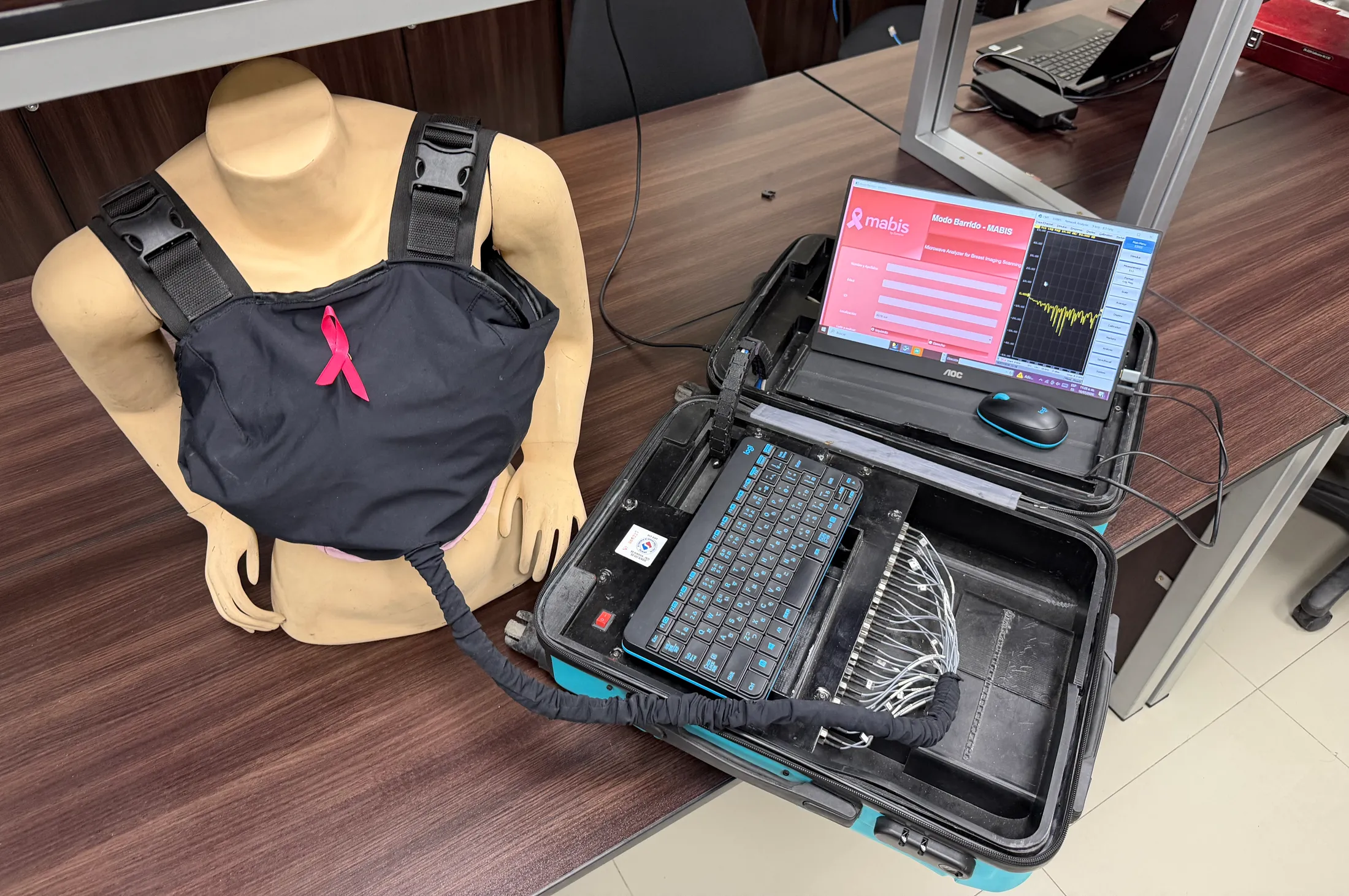

Flagship product · TRL 6
A portable, non-invasive medical device for complementary screening of suspicious regions in breast tissue, with no ionizing radiation or compression.

What is MABIS?
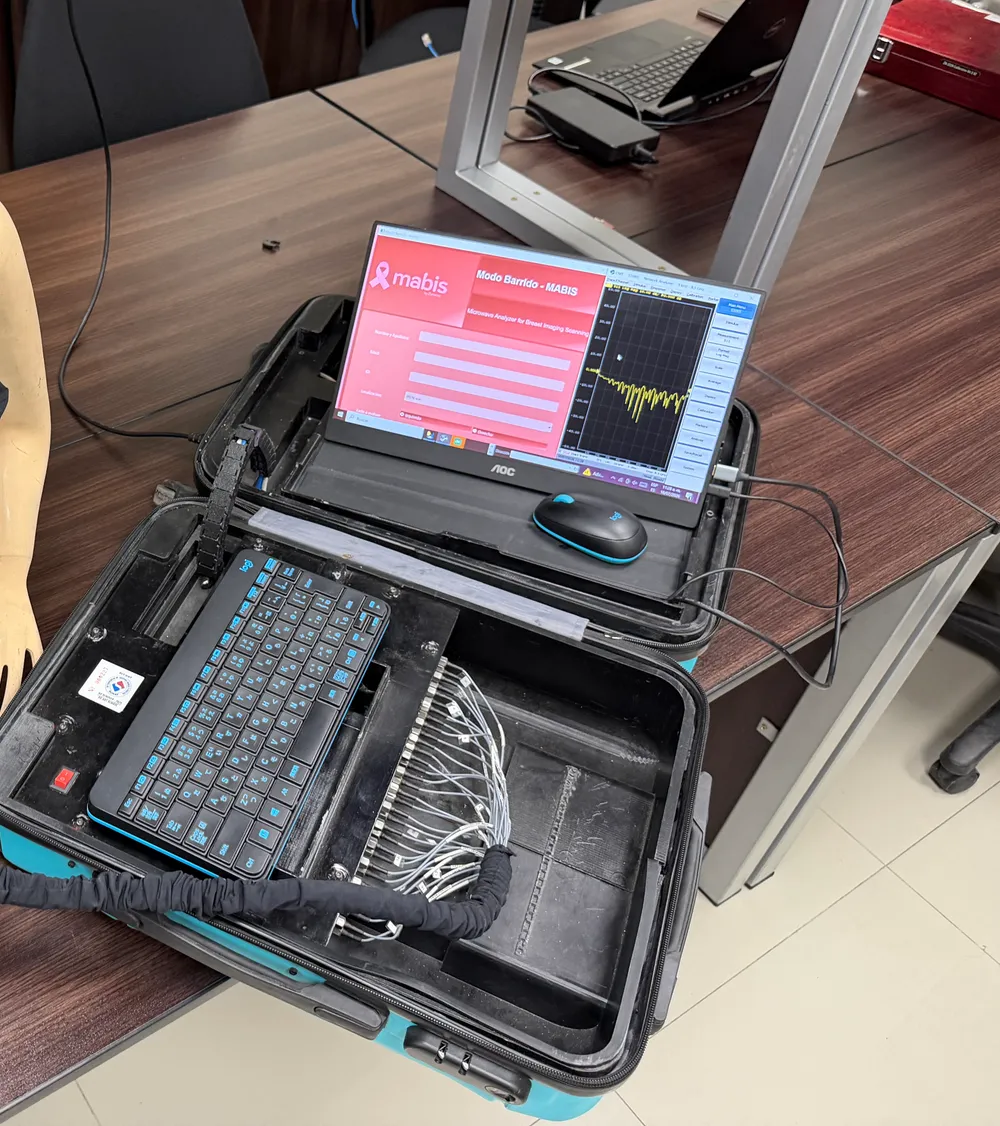
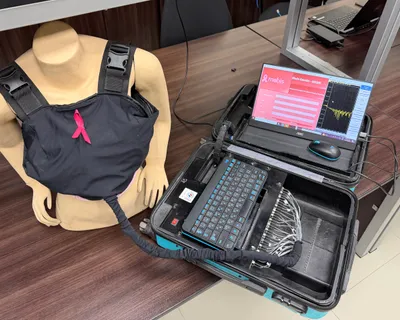
MABIS (Microwave Analyzer for Breast Imaging Scanning) is a portable medical device that uses ultra-wideband (UWB, 1–8 GHz) radar to analyze the dielectric contrast between tissues. An adaptable bra with 32 electromagnetic sensors conforms to each patient’s morphology, connected to a processing unit housed in a medical-case format.
How it works
The full procedure takes place in-office, with no special preparation for the patient.
- 1
Bra fitting
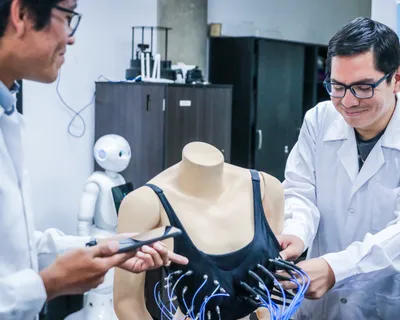
The 32 electromagnetic sensors are positioned over the breast tissue using a bra that adapts to each patient’s morphology.
- 2
Scanning
The UWB radar (1–8 GHz) measures the dielectric contrast between tissues, with no ionizing radiation or breast compression.
- 3
Image reconstruction
DAS/DMAS reconstruction algorithms convert the radar signals into 2D/3D maps of the scanned tissue.
- 4
Report and follow-up
An AI-assisted report identifies suspicious regions; the patient and medical staff access results through a remote digital platform.
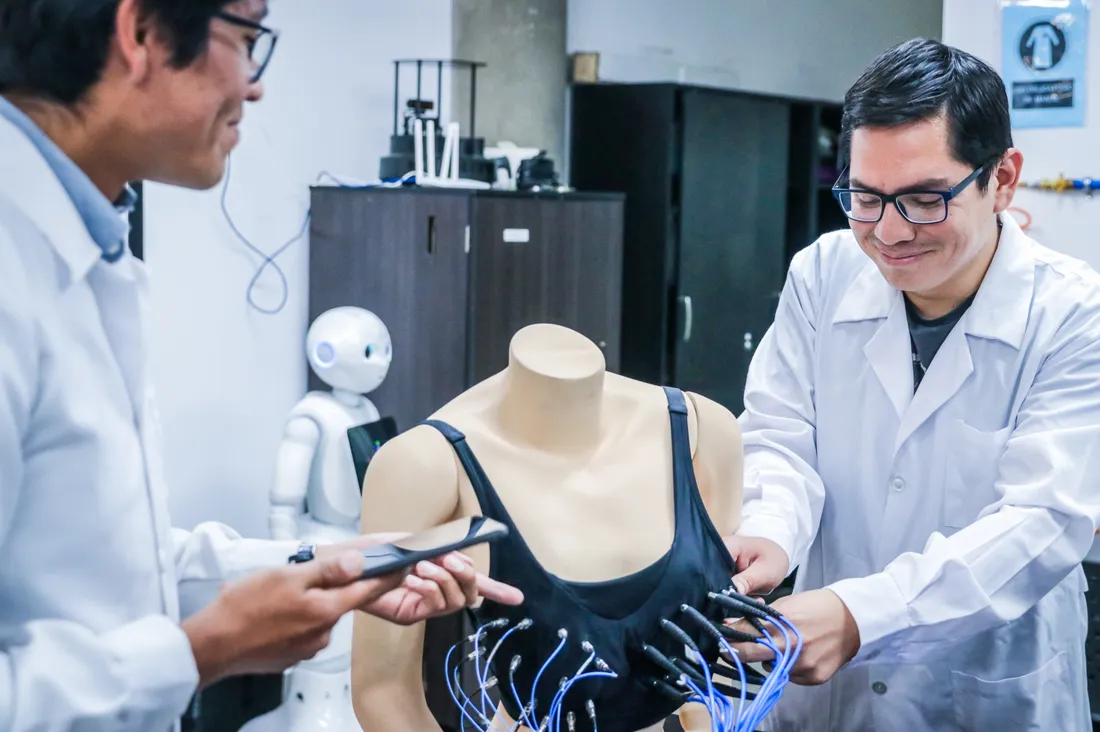
Estimated duration: ~12 minutes per breast · ~60 minutes for the full visit.
Safety and patient experience
No ionizing radiation.
No breast compression.
Maximum power of 5 dBm (3 mW) — well below the exposure limits set by ICNIRP 2020 and IEEE C95.1.
| Feature | MABIS | Mammography | Ultrasound | MRI |
|---|---|---|---|---|
| Ionizing radiation | ||||
| Breast compression | ||||
| Portable | Suitcase format | Partial | ||
| Reference equipment price | USD 20,000* | ~USD 500,000 | ~USD 100,000 | ~USD 1,000,000 |
| Connectivity and remote reports | Limited | Limited | Limited |
*Reference equipment prices; they may vary by configuration and market.
95% of comfort reported by users
Results from ongoing clinical trials. Device under validation, pending DIGEMID regulatory authorization.
Clinical evidence
0
patients in preclinical and clinical trials
0
specificity
0
sensitivity
0
comfort reported by users
Phase 2 clinical trials at AUNA clinics, in collaboration with IREN-SUR hospital. MABIS is positioned as a complement to conventional methods, not a replacement.
Clinical validation program
MABIS is in Phase 2 clinical trials at AUNA clinics, in collaboration with IREN-SUR hospital. The study compares the system’s findings against the conventional reference methods —mammography, ultrasound, tomography and biopsy— under a standardized data collection protocol.
Technical specifications
| Technology | Ultra-wideband (UWB) radar, 1–8 GHz |
|---|---|
| Sensors | 32 electromagnetic sensors |
| Format | Portable unit in a medical case |
| Maximum power | 5 dBm (3 mW) |
| Image processing | DAS/DMAS algorithms → 2D/3D maps |
| Reports | AI-assisted, plus a remote-access digital platform |
| Duration | ~12 min per breast · ~60 min full visit |
| Technology readiness | TRL 6 |
Intellectual property
- Utility model patent filed with INDECOPI — File No. 003065-2024/DIN.
- International PCT application — File No. PCT/PE2025/050037.
- MABIS trademark registered with INDECOPI (class 10) — Certificate No. 00361748, Resolution No. 025980-2024/DSD-INDECOPI. Licensed by UCSP to Zamenis.
Scientific backing
MABIS is built on in-house research from the UCSP radiofrequency group, backed by peer-reviewed scientific publications:
 Flagship publication · Q1 journalIEEE · TIM 2026
Presents the hardware implementation and preclinical evaluation of MABIS: a 2–7 GHz multistatic radar with a sensor bra, capable of generating 2D and 3D images of breast tissue.
San-Román-Castillo, Condori Huayna, Fernández-Aranzamendi, Valdivia-Silva, García-Lampérez, Segovia-Vargas
IEEE Transactions on Instrumentation and Measurement, vol. 75, 2026
 MDPI · Cancers 2024
Dielectric characterization of ex-vivo breast tissue from 70 patients: permittivity patterns make it possible to differentiate between benign and malignant tumor types.
Fernández-Aranzamendi, Castillo-Araníbar, San Román Castillo, Oller, Ventura-Zaa, Eguiluz-Rodriguez, González-Posadas, Segovia-Vargas
Cancers, 16(4):793, 2024
- Vivaldi Antennas20242024
Vivaldi Antipodal Slotted Antennas Design for Brain Anomaly Detection Systems
Design of antipodal slotted Vivaldi antennas aimed at brain anomaly detection systems, extending the group's technology platform.
Quispe-Atencio, Fernández-Aranzamendi, Castillo-Araníbar, San Román Castillo, González-Posadas, Segovia-Vargas
2024
- IEEE iWAT2022IEEE iWAT 2022
Development of a low-cost UWB switching matrix using commercial components and a DAS algorithm, the basis of MABIS's near-field radar system.
Condori Huayna, San-Román-Castillo, García-Lampérez, Segovia-Vargas
2022 International Workshop on Antenna Technology (iWAT), Dublin, Ireland, 2022
Looking to bring MABIS to your institution?
Let’s talk about traction, clinical evidence and regulatory roadmap for clinics, hospitals and health institutions.
Go to Investors